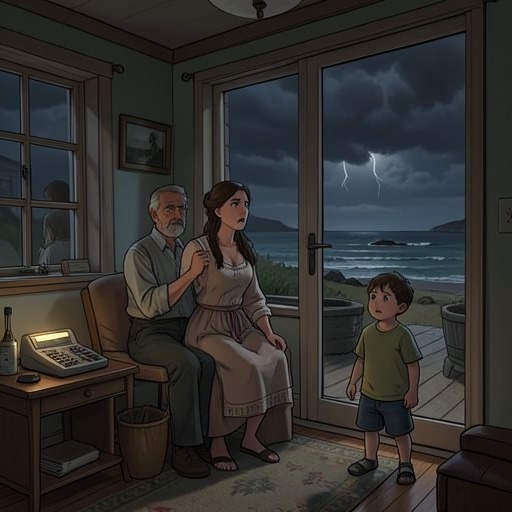
Sophia’s superstitious fear for her father
The Summer BookSophia’s superstitious fear for her father turns a scattering of coincidences into an urgent threat: crossed objects on his desk seem to announce that he may die before the moon sets. The episode makes that fear consequential without settling whether its signs have supernatural force. Sophia moves from trying to interpret omens to demanding a remedy, while Grandmother responds not with certainty but with a ritual that gives fear a practical shape.
Inherited Beliefs and the First Signs
The immediate warning is prompted by a conversation about Grandmother’s own grandmother, who used to predict death from crossed knives or dreams of black birds. Those predictions, Grandmother explains, were inventions made out of boredom and used to tyrannise the family. The explanation offers Sophia a natural account of superstition: fear can be deliberately produced and wielded. It does not, however, prevent her from treating the old signs as dangerous.
Earlier, Sophia has dreamed about a guinea pig and asked Grandmother to promise not to break any bones before the moon sets. The request makes her anxious attention to omens visible before the central discovery. Later, several small events appear to gather into a pattern: the milk goes sour, a stickleback is caught in the net, and a black butterfly flies into the house and lands on a mirror. The narration presents these occurrences as real, but their meaning remains uncertain; it is Sophia who connects them to impending harm.
The decisive sign is on her father’s desk. Sophia finds a knife and a pen crossed there, separates them at once, and runs to Grandmother’s room. Her haste shows that the danger is no longer an abstract interest in folklore. She whispers that something has happened and insists that nothing Grandmother can say will make it better. The crossed objects have acquired the force of a prediction, even though the earlier explanation has already exposed how such predictions can be made up.
A Threat Measured by the Moon
Grandmother tries to explain the family history of these fears: her grandmother’s omens were fabrications, not reliable knowledge. Sophia refuses the reassurance and tells her not to say anything more. Her response is significant because she does not merely fail to be comforted; she actively closes off the explanation that might undo the omen’s power. As evening advances, she interprets the surrounding world through the same anxious frame.
The changing landscape seems to supply further signs. The midges disappear, frogs begin singing, and dragonflies appear dead. Red clouds sink into yellow ones, and the full moon rises over a juniper bush. Sophia also notices footprints where no one could have stepped, crossed branches, and a single red blueberry bush among green ones. The narration gathers these details into a landscape that seems to possess a secret language, but Sophia’s question is not simply what the signs mean: she cannot see how they could help her father. The approaching moonset gives the fear a deadline, making uncertainty feel like an emergency.
The Search for a Remedy
Sophia searches for herbs to make an elixir for her father, but finds only ordinary plants. The search exposes a problem at the heart of her attempt to act: she has inherited the belief that some plants can help, but lacks a dependable way to identify them. The imagined herbs should be small, with soft pale stems, and perhaps mouldy, growing in swampy places; even these criteria remain uncertain. She cannot tell which plants qualify or whether the features she imagines have any real authority.
She turns to Grandmother for the missing recipe, asking what kind of herbs her own grandmother used to cook. Grandmother says she has forgotten. To Sophia, forgetting is not a minor lapse but the collapse of the only practical knowledge she hoped to recover. She demands to know how she is supposed to save her father before the moon sets. When Grandmother puts aside her book and takes off her glasses, the conversation shifts from explanation to action: she gets up and begins to dress. Sophia urges her to hurry, even telling her to leave the stockings and corset behind.
Grandmother’s Moonlit Ritual
Sophia’s fear intensifies into tears when she sees the moon over the sea. Its setting, she thinks, follows its own schedule and could happen all at once. Grandmother responds by imposing a temporary rule: Sophia must not speak, sneeze, cry, or belch until they have gathered what they need. They will put the collected things in the safest place they can find and let them work from a distance. The instructions do not prove that the ritual will protect anyone, but they replace helpless waiting with a sequence of tasks.
On their walk across the island, Grandmother gathers the head of a beach pea, two small pebbles, and a wisp of dry beach grass. In the woods she adds tree moss, a piece of fern, and a dead moth, bending from time to time to collect another ingredient. Sophia follows silently. With each object Grandmother puts in her pocket, Sophia’s nerves grow a little calmer. The accumulating contents are deliberately modest: an improvised collection from shore and woods, rather than a recovered recipe or an identified medicinal plant.
In the moonlight, Grandmother’s steady movement, stiff legs, and walking stick take on a monumental aspect. The narration presents her as watching over fate and the island, while Sophia sees her carrying the moon on her head. That image registers a change in Sophia’s experience: the night that had been crowded with portents becomes serene as Grandmother continues to gather what is needed. Back at the house, Sophia again insists that they remain quiet and leave the collection in Grandmother’s pocket. Grandmother adds a piece of rotting wood from the steps, then goes to bed. The moon sinks into the sea, and there is no cause for alarm. The ending offers relief, but no confirmation that the objects averted misfortune; the episode leaves coincidence, belief, and protection unresolved.